Home What We Do Our Team Recent Deals In The News Press Room Contact

U.S. News & World Report Navios Maritime Holidngs, Inc. Financial Times

Sheldon Goldman quoted in " U.S. New & World Report", Business Buffet -When hungry investors want to make a meal of a company, they can pool their millions in something called a SPAC, January 30, 2006

Click here for the full article in USNews.com

When hungry investors want to make a meal of a company, they can pool their millions in something called a SPAC
By Kit R. Roane -

You may think that "SPACs" sound like something to keep your feet dry or the kind of gift sure to be returned. But for investors hoping to make a killing on a leap of faith, special purpose acquisition companies are hot commodities.

SPACs are publicly traded shell companies, meaning they have no business operations and exist as little more than a name until investors pump money into them. The payoff comes if a SPAC's management team is savvy enough to purchase an undervalued private company within a specific field--like shipping--and then run it successfully as a public company. In a perfect world, that private company would be bought at a fraction of what it is later valued at on the public market.

Such investment vehicles have been luring some big names. Steven Berrard, the former CEO of Blockbuster Entertainment Group, now heads a SPAC called Services Acquisition Corp. International, and Apple Computer cofounder Steve Wozniak is helping shepherd another SPAC called Acquicor Technology. A few top banks have also begun underwriting the deals, including Citibank and Deutsche Bank. The latter recently priced a 20 million-share offering for a real-estate SPACcalled Cold Spring Capital, raising $120 million.

In all, more than 50 SPACs filed to go public in 2005. About half of these, including Cold Spring Capital, have made it to market, raising around $1.2 billion that can be used for acquisitions. By comparison, only 11 deals went public in 2004, and those raised less than $500 million.

The special units have some obvious benefits for underwriters and venture capitalists--fat fees and a cut of the action at a discount. Other insiders, like the officers and directors of the SPAC, can accumulate a lot of the stock for cents on the dollar. Meanwhile, hedge funds are attracted to the upside inherent in the deals if the SPAC team finds a good undervalued private company to take public, as well as the cash on hand prior to the acquisition. For the acquired company, merging into a SPAC helps it gain access to public financing in less time and with far less cost than if it attempted its own initial public offering.

The wrinkle. For other shareholders, it's more of a gamble. They are putting their trust in a management team, expecting it to both find hidden assets and run them well. Other than the possibility of fraud, that is perhaps the most serious wrinkle in a SPAC and the toughest thing for outside investors to gauge. "Just because you run IBM, for example, doesn't mean you are exceptional at acquiring companies," says Sheldon Goldman, senior managing director at Sunrise Securities, one of the most active SPAC underwriters.

But Goldman adds that the investment units are attractive to a lot of investors, particularly the institutional kind, because they offer more control than can be had in the private equity market and because SPACs allow large investors to tailor their exposure to specific industries. "You want coal? I can show you coal with a specific management team," he adds. "And there is downside protection, so if you don't like the deal, you walk."

Safeguards. There are three protections usually baked into the product. At least 80 percent of the funds collected are set aside in escrow for the acquisition (although they can also be tapped for litigation costs if investors and the SPACs get into a disagreement). Any acquisition requires shareholder approval. And if no acquisition takes place within a specified time, typically 18 months, at least 80 percent of the funds invested in the shell com-pany are supposed to be returned to investors.

Many contend that SPACs are little removed from the much-maligned "blind pools" of the 1980s, which several stockbrokers and promoters used to fleece investors. Abuses in blind pools caused the Securities and Exchange Commission to step up enforcement, and several state attorneys general set up regulations that either prohibited or severely curtailed their operations.

One of the most notorious blind-pool scams of the 1980s was a Fort Lauderdale, Fla., shell company called Hughes Capital Corp., which raised more than $650,000 from investors, promising to plow the money into profitable private companies. Instead, the Hughes blind pool turned out to be a plain old "pump and dump" stock swindle allegedly dreamed up to help pay off a former stockbroker's mob debts.

SPAC-style investments had another brief life in the 1990s before the frothy dot-com market took away their thunder. Not everyone is happy to see them again. One Barron's columnist wrote in December that SPACs were among a host of Frankenstein-like products Wall Street has created that "should never be allowed to see the light of day," comparing them with portfolio insurance, Internet-only mutual funds, and Pets.com. Meanwhile, the SEC is giving SPACs a harder look. And several state attorneys general are opposing their listing on the American Stock Exchange. SPAC insiders say this is largely because the listing exempts companies from most states'securities registration requirements known as "blue sky" laws. These regulations can effectively bar SPAC registration. Officials also don't like the patina of respectability an AMEX listing gives, whether deserved or not.

The AMEX counters that all SPACs are scrutinized to ensure that they meet the board's listing requirements, while SPACunderwriters say regulators misunderstand the product. "We need to better explain the investor protections incorporated in the SPACstructure now," says Steve Levine, CEO of EarlyBird Capital, another active underwriter. He notes that regulators are seeing them as old-style "blank checks" or blind pools, when they really aren't.

Perhaps. But even if they are well run, SPACs may have inherent flaws. One is that companies being wooed for a takeover know roughly how much money the SPAC needs to spend and how long the SPAC has to complete a deal. Those are great details for the acquired company to know but not information an acquirer would generally advertise. And investors basically write off up to 20 percent of their investment immediately, since that is the amount that can be used for expenses other than the acquisition.

Not that investors seem to care much right now. The product is so hot that underwriters have recently begun packaging SPACs for the less regulated United Kingdom market as well. There, SPACs don't have to worry about the SEC proxy guidelines, and there are no rules that they must use 80 percent of their funds for their initial acquisition. That means deals can be completed even more quickly. Whether or not they should be remains an open question.


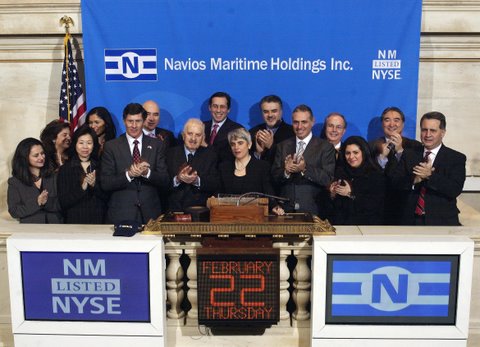
February 22, 2007
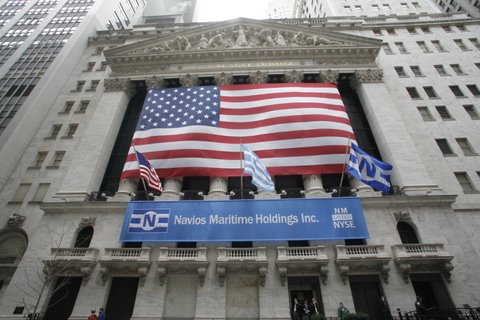
Navios Maritime Holdings, Inc. (NYSE-Listed NM) celebrated its transfer
from Nasdaq to the New York Stock Exchange. In honor of the occasion,
Chairman and CEO Angeliki Frangou rang The Opening Bell.


Click here for the full article on FT.com

'Spacs' make their debut on this side of the pond
By David Blackwell
Published: February 24 2006 02:00 | Last updated: February 24 2006 02:00

One of the more ugly Americanisms to emerge in recent years is the verb to de-spac. Brace yourselves, for it has now crossed the pond, courtesy of Aim.

De-spacing, pronounced "dee-spacking", is the term used when a special purpose acquisition corporation - or spac - makes its first acquisition.

This week, one of the first spacs to join Aim did just that. Energy XXI announced plans to acquire Marlin Energy, an oil and gas producer in the Gulf of Mexico, for $421.1m (�241.6m).

Coincidentally, KBC Peel Hunt this week announced plans for the $75m flotation of Platinum Diversified Mining, which hopes to become the fourth spac to join the junior market.

The spac trail has been blazed by Collins Stewart, which late last year brought Energy XXI to market along with IRF European Finance Investments and International Metal Enterprises. Working in conjunction with Sunrise Securities, a privately held New York investment bank, Collins Stewart helped the three to raise $750m between them.

Spacs have been around for a long time in the US but they have tended to raise only $20m to $30m at a time, and have been aimed at retail investors. However, Sunrise Securities took the idea to a new level last year by developing a spac for US institutions and Collins Stewart picked up the baton in the UK.

Investors in the Collins Stewart-led spacs bought units consisting of one share and two warrants. For all three, the price of a unit was $6.

The shares were backed by cash as more than 90 per cent of the money raised was put into a trust. The balance covered fees, expenses and working capital, while the unpaid management looked for acquisitions.

Energy XXI has become the first to find a deal, which will be classed as a reverse takeover under Aim rules. Marlin Energy's properties in the Gulf of Mexico have estimated reserves of 25m barrels of oil equivalent (boe).

They were producing at the rate of 11,800 boe per day before the two hurricanes last year. The new owners are expecting production to peak at 14,000 boe per day in 2008.

Investors originally buy into both the industry that the spac is intending to enter and into the expertise of the management team in that industry. The management has to come up with a deal within 18 months but the deal cannot go ahead without a shareholder vote in favour.

It looks unlikely that Energy XXI's backers will turn down Marlin. As John Schiller, chief executive, said on Wednesday: "We committed to the market when we went public on Aim that we intended to effect a Gulf of Mexico transaction within four to six months, and today we have successfully demonstrated our ability to execute our strategy."

IRF European Finance Investments is looking for an acquisition in the banking sector in southern Europe and International Metal Enterprises is looking for opportunities throughout the metals industries. The shares and warrants for both spacs are trading above the unit price of $6.

The advantage to investors of a spac is that if they do decide to reject a planned acquisition, they can get most of their money back from the trust. They also have several options - keeping or selling both the shares and the warrants, and selling the shares and keeping the warrants.

In effect, spacs are large cash shells that allow managements to move faster than the traditional Aim cash shell, where such a small amount is raised that management has to return for further talks with each investor once a target is identified. They look ideal vehicles for investing in the resources sector, where large corporations are willing to sell off marginal assets that in many cases are underinvested.

As ever, there are no guarantees. At the end of 2004, Sunrise Securities raised $200m for International Shipping Enterprises, which last August acquired Navios Maritime Holdings for $600m. The company moved to Nasdaq at $5.47 a share in November but, after a fall in dry cargo freight rates, the shares were trading yesterday at about $4.63.

Nevertheless, it looks as though spacs are here to stay on Aim - another example of the attraction of the regulatory regime to American businessmen. And there is little doubt that any successes will add to the junior market's growing international reputation.

Disclaimer